Snow Leopard: Panthera Uncia
by Corte Smith
 In 1972, the IUCN placed
the snow leopard on its Red List of Threatened Species as ‘Endangered’. Due to
the high demand for their coats, snow leopards are illegally hunted for the fur
trade. The pelts are a sought-after commodity in places like Central Asia,
Eastern Europe and Russia where they are turned into coats and other garments.
Snow leopard bones and body parts are also used for traditional Asian medicine.
In 1972, the IUCN placed
the snow leopard on its Red List of Threatened Species as ‘Endangered’. Due to
the high demand for their coats, snow leopards are illegally hunted for the fur
trade. The pelts are a sought-after commodity in places like Central Asia,
Eastern Europe and Russia where they are turned into coats and other garments.
Snow leopard bones and body parts are also used for traditional Asian medicine.
by Corte Smith
 |
| Snow Leopard |
Description:
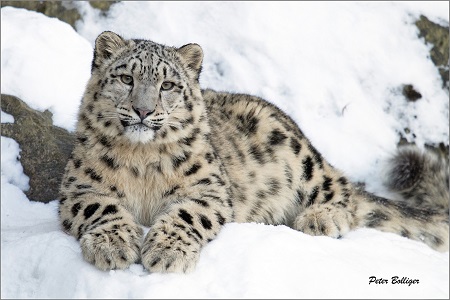
The snow leopard's fur, which is thick with hairs between 5 and 12 cm long, is whitish to gray with black
spots on head and neck, but larger rosettes on the back, flanks and bushy tail. Its tail is 80 to 105 cm long. Its body is stocky, short-legged and slightly smaller than the
other cats reaching a shoulder height of 56 cm, and ranging in head to
body size from 75 to 150 cm. Its eyes
are pale green or gray in color. Its muzzle is short and its forehead domed.
Its nasal cavities are large. It weighs between 22 and 55 kg, with an
occasional large male reaching 75 kg and small female of under 25 kg.
Snow Leopards lives no longer than 20 years, however can live up to 28 years in
captivity.
 |
| Where to find Snow Leopards |
The Snow
Leopard can be found in the mountain ranges of Central and South Asia. The
global population is estimated to
number 4,000- 7,000 mature individuals. The population is declining about 10%
in the next 23 years.
The snow leopard inhabits alpine
and subalpine zones at elevations from 3,000 to 4,500 m, ranging from
western Afghanistan to Mongolia and western China. In the northern range
countries, it also occurs at lower elevations (Snow Leopards."Wikipedia").
Ecology:
The snow leopard is
solitary, except for females with cubs. They hide their cubs in dens in the
mountains for extended periods.
 |
| Mother and her cubs waiting outside den |
An individual snow
leopard lives within a well-defined home range, but does not defend its
territory aggressively when encroached upon by other snow leopards. Home ranges
vary greatly in size. Where prey is abundant, a home range may be as small as
12 km2 to 40 km2 and up to five to 10
animals are found here per 100 km2; in habitats with sparse
prey, though, an area of 1,000 km2 supports only five of these
cats. However, a new study lasting from 2008 to 2014 indicates their ranges are
much greater than believed; a male snow leopard requires a territory of around
80 square miles, while females require up to 48 square miles of territory.
Taking this data into account, it is estimated that 40 percent of the 170
protected areas in place are smaller than the space required to support a single male
snow leopard.
Behavior:
 |
| Snow Leopards camouflaged while napping during the daylight |
Like
other cats, snow leopards use scent marks by scraping the ground with
the hind feet before depositing urine or scat, but they also spray
urine onto
sheltered patches of rock to indicate their territories and common travel
routes.
Snow leopards are
most active at dawn and dusk They are known for being extremely secretive and
well camouflaged (Sayano).
Diet:
Snow Leopards are one of the top predators in the high mountain
food web of Central Asia. The Snow Leopard can kill prey three times their
weight. Blue Sheep and Ibex are some of the Snow Leopards favor meals (“What”).
 |
| Snow leopard stocking a goat |
Snow Leopards are Carnivores that are
opportunists when it comes to feeding. They ambush their predators and will
attack from above when possible. The Snow Leopard can jump as far as 14 meters
to catch its prey. The Snow Leopard will feed on its kill for 3 to 4 days (“Snow Leopard- Facts”).
Snow Leopard Conservation
Status:
 In 1972, the IUCN placed
the snow leopard on its Red List of Threatened Species as ‘Endangered’. Due to
the high demand for their coats, snow leopards are illegally hunted for the fur
trade. The pelts are a sought-after commodity in places like Central Asia,
Eastern Europe and Russia where they are turned into coats and other garments.
Snow leopard bones and body parts are also used for traditional Asian medicine.
In 1972, the IUCN placed
the snow leopard on its Red List of Threatened Species as ‘Endangered’. Due to
the high demand for their coats, snow leopards are illegally hunted for the fur
trade. The pelts are a sought-after commodity in places like Central Asia,
Eastern Europe and Russia where they are turned into coats and other garments.
Snow leopard bones and body parts are also used for traditional Asian medicine.
There are numerous agencies
working to conserve the snow leopard and its threatened mountain ecosystems.
These include the Snow Leopard Trust, the Snow Leopard Conservancy and the Snow
Leopard Network. Their focus on research, community programs in snow leopard
regions and education programs are aimed at understanding the cats needs as
well as the needs of the villagers and herder communities impacting the snow leopard’s
life and habitat (“Snow Leopard- Facts”).
What you can do:
You can directly support these efforts by joining the International Snow Leopard Trust or – even better – by purchasing some of the handicrafts made by the people who are the MOST important link in ensuring the cats survive in the wild for ever. Please visit The international Snow Leopard Trust Web-site: www.snowleopard.org for more general information about snow leopards in the wild. Go to the Irbis Enterprises Web-site to see products made by the herders and to learn more about conservation efforts in Mongolia www.irbis-enterprises.com Thanks so much for your passion for cats, they need all the help we can give("Saving")!
Interesting facts:
 |
| Snow Leopards playing |
Snow leopards are very
playful, love to roll in the snow. They often slide down a steep hill at the
back and at the end they quickly turn over and fall into the snow on all four
paws. After the games, or hunting they make themselves comfortable to bask in
the sun.
Being in a good mood, the
snow leopard purrs just like a house cat. Snow Leopards also can not roar (Sayano).
Sources:
https://bigcatrescue.org/save-snow-leopards/
“Saving The Snow Leopards.” Big Cat Rescue, 17 Jan. 2018, bigcatrescue.org/save-snow-leopards/.
http://snowleopardconservancy.org/wp-content/uploads/2017/09/bolliger-resized-sl1.jpg (photo)
“Saving The Snow Leopards.” Big Cat Rescue, 17 Jan. 2018, bigcatrescue.org/save-snow-leopards/.
http://snowleopardconservancy.org/wp-content/uploads/2017/09/bolliger-resized-sl1.jpg (photo)
Sayano-Shushenskiy
Reserve. “About the Snow Leopard.” ABOUT THE SNOW LEOPARD, Russian
Geographical Society, 2017,
www.rgo.ru/en/projects/protection-endangered-species-snow-leopard/about-snow-leopard.
“Snow
Leopard - Facts, Diet & Habitat Information.” Animal Corner,
2018, animalcorner.co.uk/animals/snow-leopard/.
“Snow
Leopard.” Wikipedia, 22 Feb. 2018, 12:36,
en.wikipedia.org/wiki/Snow leopard.
“What do snow leopards eat?” Snow Leopards for Kids, Snow Leopard Conservancy, 2008, http://snowleopardconservancy.org/kids/text/leopardfood.htm.

Wow they are beautiful! The range they have is indeed a dangerous place to be. I will check out the link to help them.
ReplyDelete-Colin Scharff
Your blog was very fun to read, I appreciate the amount of background information and interesting facts you gave about the Snow Leopard. It is so sad to see such a beautiful animal, similar to the case of the African Elephant, be illegally hunted for its furs and bones for trade. Hopefully the educational and awareness programs will help to encourage political action that will help the Snow Leopard. Thank you!
ReplyDelete-Amanda Stahler
The snow leopard's are such beautiful animals it is sad to know that they are endangered species. I took a second to visit the International Snow Leopard Trust Website and was pleased to notice that many have interacted with this website. I hope to see a quick recovery for the Snow Leopard species soon.
ReplyDelete^^^^ Amanda Sandoval
ReplyDeleteIt is interesting that a single snow leopard is able to feed on the same hunt for up to three days. I figured another snow leopard may come in and steal the meal. Maybe this will be an effect the reduction in habitable area for the snow leopard. -Patrick Shami
ReplyDeleteThis snow leopard by amazing to read but yet still sad because of their endangerment of this stunning animals. I was surprised to find out that male snow leopards have a much larger home range than females, which I can also see how this is making recovery plans harder. I also think it is very cute how the snow leopards can purr instead of roaring. It is sad to find out that their fur is so prized and used in places like Russia to the point that they are now endangered. I hope those different Trusts and Recovery Networks will help the beautiful snow leopard to recover!
ReplyDelete--by Charlotte Smith
Ugh such beautiful animals! Loved learning about them, always have been fascinated by big cats. So terrible that they are being hunted for their coats. I hope people learn to respect the beautiful creatures we have on this planet.
ReplyDelete-Sarah Sebor
The picture of the two playing in interesting facts is so awesome first of all. Also I had no clue their range was so large and it makes sense that they are so rarely seen. I really liked the blog!
ReplyDelete-Edmund Slevin
It is really sad and interesting if you think about how secretive and hidden they are in the wild yet people have still been able to hunt and capture them to the point of endangerment. I'm really curious as to how people can actually catch such an illusive species.
ReplyDelete-Claire Swart
It's so sad that we've exploited these beautiful animals. I had no idea they lived a solitary life, but I guess it makes sense when thinking about the cats I know. I also appreciate that you added an interesting facts section I thought that was super sweet.
ReplyDeleteSasha Shebalin
Hi Corte! Well done.
ReplyDeleteI had no idea they can kill something up to 3 times their weight - scary! I also didn't know that they live to be around 20 years old, I would've assumed longer. Thank you for teaching me something about Snow Leopards!
Riley Shannon
The snow leopard is an incredibly beautiful animal, no wonder their fur is in such high demand. "it is estimated that 40 percent of the 170 protected areas in place are smaller than the space required to support a single male snow leopard." That data is very alarming, they are much like the Florida panther that I did, with massive home ranges. Good job on your blog.
ReplyDeleteShane Simpson