The Florida Panther

National Geographic Blog
About the Florida Panther:
MySuncoast.com
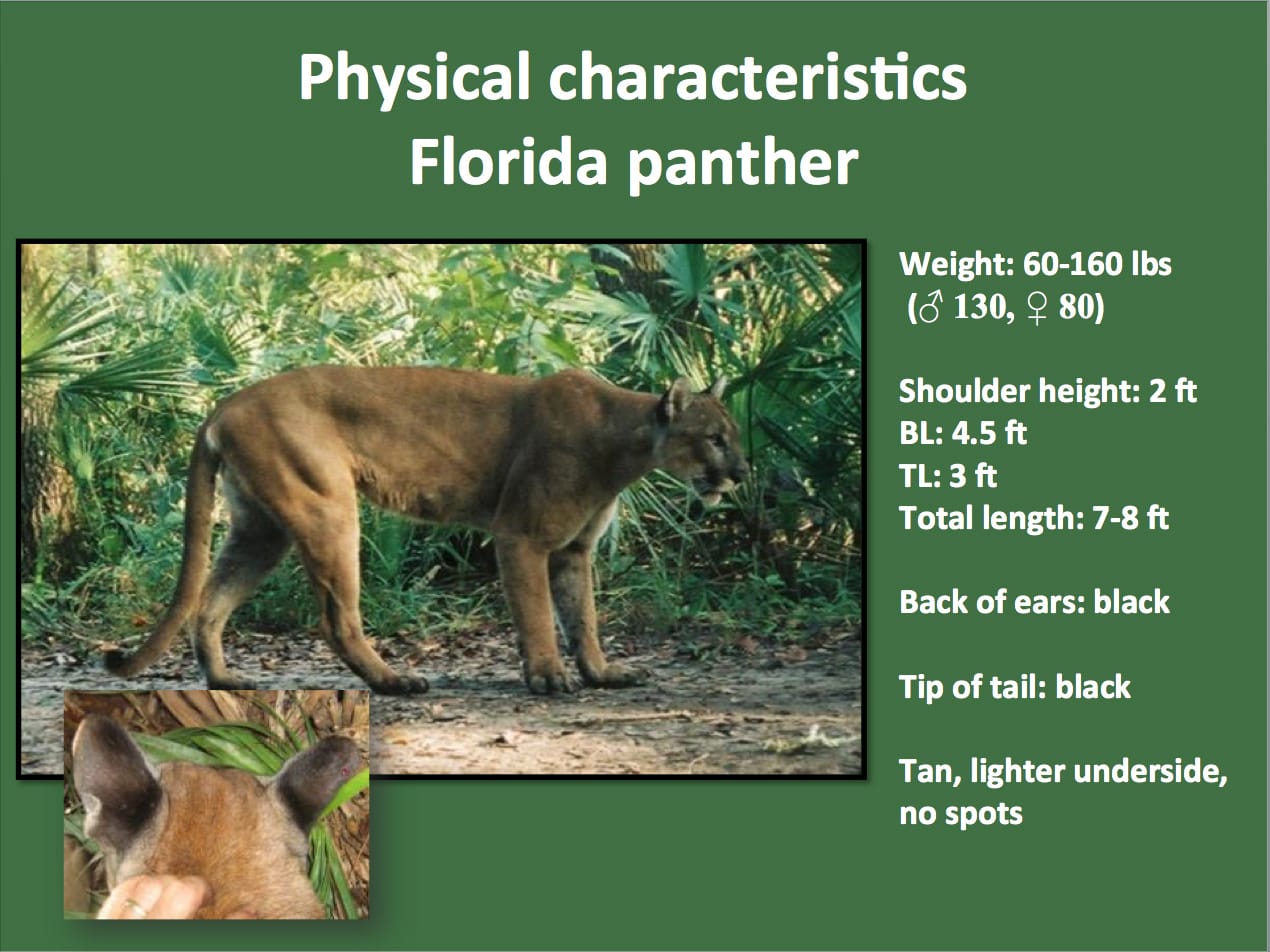

Ralph Arwood Photography
Why is the Florida Panther so Important?
Panthers are an umbrella species, therefore, they protect and preserve the ecology of the expansive landscapes and habitats panthers live in. Florida panthers keep the populations of feral hogs, deer, raccoons and other prey balanced and robust (Basic).
What Caused the Florida Panther's Population to Dwindle? What are the Threats Today?
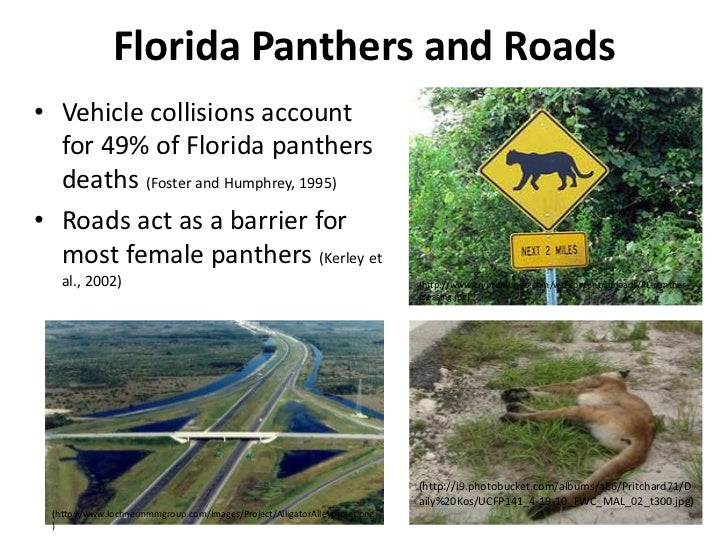
In 1892 a bounty was placed on panthers because they were perceived as a threat to humans, livestock, and game animals. Consequently, by the mid-1950s the species was nearly extinct (Species). In 1967 the Florida panther was named an endangered species, the population was decimated to only 12 to 20 individuals (Threats). Today, habitat loss, roadkill, and genetic diversity are the main drivers that inhibit panther population growth.
 |
| Ethan Strickler: Slideshare |
As the Florida panther's population declined and became isolated from subspecies, inbreeding became commonplace. This greatly suppressed the genetic diversity of the panther population. In 1995 the U.S. Fish and Wildlife Service temporarily released eight female panthers from Texas to genetically restore the Florida panther population. This program succeeded and the Florida panther population tripled in 11 years (Florida).
Recovery Plan:
The recovery plan (Recovery):
 |
| Big Cat Rescu |
- Restore and expand the panther population and habitat in south Florida.
- Expand this population to south-central Florida.
- Reintroduce at least two panther populations outside of south and south-central Florida within their historic range.
- Create public awareness and educate the public about the cause.
- Incentivize private landowners to retain and protect panther habitats.
- Conserve the habitat and have thorough and careful land use planning.
- Minimize habitat damaging threats.
 |
| Unturned Wiki-Fandom |
- Adopt a Panther- This helps Defenders of Wildlife work with state and local officials to preserve the habitat and construct highway underpasses.
- Send a message to government regulators and officials.
- Talk to friends, neighbors, and family about why protecting wildlife matters.
- Stay informed.
Resources Used:
“Basic Facts About Florida Panthers.” Defenders of
Wildlife, 3 Oct. 2016, defenders.org/florida-panther/basic-facts.
The Florida Panther Recovery Team. “Florida Panther Recovery
Team.” Florida Panther Recovery Team,
13 Mar. 1995, pp. ii-216. https://ecos.fws.gov/docs/recovery_plan/081218.pdf
“Florida Panther: Species Profile.” National Parks Service, U.S. Department of the Interior,
www.nps.gov/ever/learn/nature/floridapanther.htm.
“Threats to Florida Panthers.” Defenders of Wildlife, 19 Sept. 2016,
defenders.org/florida-panther/threats.

This is a great expansion of what we learned in class about the Florida Panther. This helped me understand the recovery plan much better, thank you.
ReplyDelete-Colin Scharff
The poor Florida Panthers have gone through so much ranging from being hunted to habitat lost. Thank you for presenting information about them so clearly and describing how important they are to the preserving the ecology of their habitat. I would love to learn more about the "adopt a panther" program! Thank you!
ReplyDelete-Amanda Stahler
This was a very cool blog to see. I am glad some one decides to do this and expand on the knowledge we learned in class about the Florida Panther. They look extremely like the mountain lions we have in California but at the same time they have their differences.
ReplyDelete-Corte Smith
I really enjoyed reading your blog about the Florida Panthers. There was great additional information on top of what we learned in class. So how do people adopt a panther?
ReplyDelete^^^^ Amanda Sandoval
ReplyDeleteInteresting blog bringing a different perspective to the endangerment of the Florida Panther. Great presentation and expansion on what we learned in class. -Patrick Shami
ReplyDeleteWow this is really interesting as there are only around 100 of them left and that they are the only subspecies of Puma left, quite saddening though. I had never known that there had been a bounty on these animals. I can see how it'll be hard for their populations to increase because they require such a large home range. I am really glad to hear that the program in 1995 was so successful with the Panther population.
ReplyDelete-- by Charlotte Smith
So sad to hear that there are only about 100 of them left :( I hope they can make a full recovery, but it probably would be hard since their isn't much habitat left for them in Florida. Loved reading about them! Thank you for showing me a different perspective on the endangerment of this beautiful animal.
ReplyDelete-Sarah Sebor
It's crazy how many beautiful animals like this are hunted because people think they are a threat to them. I really hope the recovery plan works out and I am interested to know how the two populations that are going to be reintroduced in their historic range will fare. Good luck to the kitties!
ReplyDelete-Edmund Slevin
Honestly, its pretty weird to think about large cats living in the wild in a place like Florida because especially with the panther's current range it seems very close to human populated areas. Has there been any consideration to try to establish a different population of Florida Panthers maybe in a different region or even state?
ReplyDelete-Claire Swart
I remember hearing this case study in other classes as well. So sad that such an important animal is being destroyed by something so silly as roads. We need to build more of those land bridges for them!
ReplyDeleteSasha Shebalin
Hi! Great blog.
ReplyDeleteI can't imagine what they must look like in Florida - how random to see this animal walking around! Thank you for teaching me that I can "Adopt a Panther" I will definitely consider doing so!
Riley Shannon