Bull Trout
Salvelinus confluentus
Characteristics
The
Bull trout, or Salvelinus confluentus, is a migratory fish, native to
Northwestern North America. The bull trout is a member of the Salmonidae
family; however, it has much more specific habitat requirements than other fish
in the family. The Bull trout is rarely seen in waters above 59 degrees (F). Bull
Trout will typically swim farther up-stream than other trout in search of the
cleanest and coldest water to spawn in.

http://i.pinimg.com/originals/ba/bd/6f/babd6f56d662a49e8103f108862c88b1.jpg
Bull trout
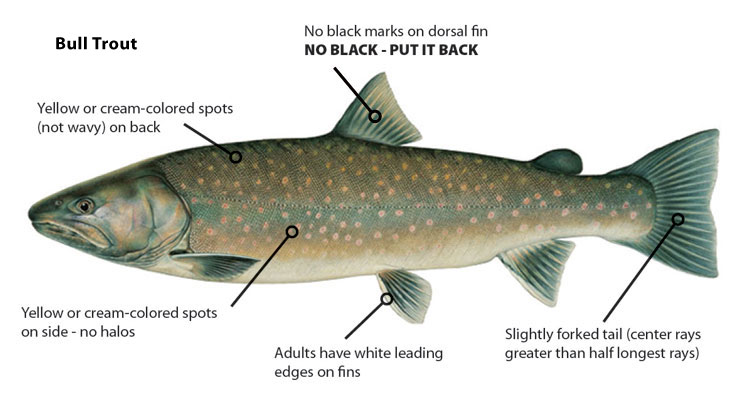
can be easily distinguished from other trout species due to their lack of spots
on the dorsal fin, olive green to bronze skin, and yellow to salmon-pink
colored spots on the fish’s back. It also does not share the same forked tail
as many other trout.
www.takenobull.org/images/articles/bull-trout-diagram.jpg
Geographic Range The Bull Trout is Native to
Northwestern-North America. To the left, you can see the range of the Coastal
Recovery Unit, put in place to help recover this threatened species. Efforts
are underway primarily in the Puget sound region, however the map shows that
the Bull Trout is being tracked and protected across Oregon and most of Washington.
The Bull Trout is Native to
Northwestern-North America. To the left, you can see the range of the Coastal
Recovery Unit, put in place to help recover this threatened species. Efforts
are underway primarily in the Puget sound region, however the map shows that
the Bull Trout is being tracked and protected across Oregon and most of Washington.
The Puget Sound region and the
Olympic Peninsula region are the only known regions to support anadromous bull
trout according to the US fish and wildlife service. An anadromous species is
one that spawns in freshwater but migrates to saltwater to mature. These
migratory trout have been reported to grow up to 35 inches long and to weigh as
much as 32 pounds!
Coastal Recovery Unit Implementation Plan for Bull Trout
Coastal Recovery Unit Implementation Plan for Bull Trout

https://ecos.fws.gov/ecp0/profile/speciesProfile?spcode=E065
Listings

https://www.fws.gov/pacific/bulltrout/pdf/~1078458.pdf
The bull trout was first put on the
endangered list as a threatened species in June of 1998. In December of 2009,
the US Fish and Wildlife service began monitoring an experimental population in
Flathead County Northwest Montana. Since then, there have also been populations
found and monitored in other nearby states such as Oregon.
Threats to the Species

The largest threat to the bull
trout is habitat degradation. Since Bull trout have such a low tolerance for
changing environments, they are an excellent indicator species for the health
of the waterways. When rivers and streams are reinforced, they cannot turn and
bend as they naturally would, therefor eliminating many of the pools and swells
that the bull trout love to live and spawn in. Humans have had an enormous effect
on the waterways and on the trout by correlation. As areas become more developed
and roadways expand, bull trout range and populations continue to shrink. Climate
change and global warming are also expediting the extirpation of the bull
trout. As ambient air temperatures rise, the stream water temp is rising as
well. This, and the reduced water flowing due to drought and redirection for
use in hydroelectric generators has completely cutoff the spawning grounds for
many of the bull trout. Since the bull trout need to swim much farther upstream
to reproduce, they are often running into roadblocks, or river-blocks, such as
damns, roads, dikes, and dry spots.


http://www.riversportfishing.com/wp-content/uploads/sea-run-bulltrout-wm.jpg
Another
large and very real threat to the bull trout is recreational fishing. They are
often mistaken for other similar types of fish and caught accidentally. The
illegal fishing of bull trout is just adding to the population decline and
could end up labeling the bull trout as an endangered species rather than just
threatened.
What is being done?
Since the addition of the bull
trout to the list of endangered species, efforts have been made by everyone
from the federal government, state agencies, and conservation activists to power
companies and local landowners. Fortunately, many of the conservation efforts
put in place to save the bull trout overlap with those put in place to save
salmon and steel head populations. Since “bull trout consistently migrate to the
furthest accessible upstream habitats in their natal watersheds and require
some of the coldest and cleanest water conditions for parts of their life
cycle,” saving the habitat upstream has a direct effect on the endangered fish downstream.
(US Fish)

https://www.americanrivers.org/conservation-resources/river-restoration/
The biggest effort being made is habitat preservation, since that is what has the largest effect on the bull trout’s survival.
It is up to us...
...to save the bull trout. By limiting our influence on naturally occurring waterways, one would have a huge impact on the survival of the bull trout as well as other trout and salmon. One can also take action by using local governments to pressure power providers to create bypasses to their damns and hydro-electric power plants so that the trout can continue their journey up stream. The easiest thing one can do to ensure the safety of the bull trout is to research local conservation agencies, and make a donation. These agencies run on limited funds and rely heavily on the donations of concerned citizens.
References
- https://www.nrcs.usda.gov/wps/portal/nrcs/detail/mt/home/?cid=nrcs144p2_057914
- http://www.endangered.org/animal/bull-trout/
- https://ecos.fws.gov/ecp0/profile/speciesProfile?spcode=E065
- crag.org/clean-water/bull-trout/
Works Cited
“Bull Trout.” Crag Law Center, crag.org/clean-water/bull-trout/.
“Bull Trout.” Endangered Species Coalition, www.endangered.org/animal/bull-trout/.
Service, U.S. Fish and Wildlife. “Bull Trout (Salvelinus Confluentus).” Species Profile for Bull Trout (Salvelinus Confluentus), ecos.fws.gov/ecp0/profile/speciesProfile?spcode=E065.
“Threatened and Endangered Species Bull Trout Fact Sheet.” USDA Natural Resources Conservation Service Montana, www.nrcs.usda.gov/wps/portal/nrcs/detail/mt/home/?cid=nrcs144p2_057914.
US Fish and Wildlife Office, and Oregon Fish and Wildlife Office. “Coastal Recovery Unit Implementation Plan for Bull Trout.” Sept. 2015, Coastal Recovery Unit Implementation Plan for Bull Trout.

Formatting appears differently when editing blog as it does when viewing published post.
ReplyDeleteGlad to see someone is making an entry about a fish! They are just as important as other animals. The problems that face them are different, and require creativity to solve. Thanks for your work!
ReplyDelete-Colin Scharff
It is sad to see that humans are directly and indirectly harming the Bull Trout though habitat degradation and global warming. Although I'm glad to see that there is effort being made towards habitat preservation. Thank you for bringing it to our attention what can be done as a community to help the Trout and for presenting the information so clearly.
ReplyDelete-Amanda Stahler
Great job on your blog! I really appreciated you defining all the terms that someone who hadn't done the research might not have known. I also really like all your pictures and diagrams -- it made it a lot more appealing to read.
ReplyDelete-Maggie Lai
Good job on all of this information that you provided! I really enjoy the layout of your blog. I found it quite interesting how these fish need such cold and clean waters, even a specific temperature. It is sad to see that habitat degradation is the biggest issue for them. But hopefully since the require similar recovery actions to those of the trout and other fish we can see this species' population increase! Thank you for also teaching me how to spot them!
ReplyDelete-- by Charlotte Smith
Your blog was very informative and easy to read. I really enjoyed learning about this species, sad to hear that most of their native environment in no longer habitable for them because of civilization. Hope they can make a full recovery!
ReplyDelete-Sarah Sebor
My dad is a big time fisherman and I grew up (in Oregon) seeing signs warning not to catch the bull trout. This is so close to home and its so awesome to finally get to learn about an animal that I thought about when I was younger. Also Jesus Christ I had no clue they could be 32 pounds that is insane.
ReplyDelete-Edmund Slevin
Really cool to see a blog about fish. Also, there is a picture above of the Bull Trout with all the its unique features and its says above the image "No black- put it back". What exactly does that mean? Is it that if there is black on the dorsal fin its not a Bull Trout or is it a farm version of the fish?
ReplyDelete-Claire Swart
It means if it does not have black on the dorsal fin, it likely is a Bull trout and you should release it back into the water. -Patrick Shami
DeleteI've owned many different types of fish so I understand how their environment very much affects their well being. It's a delicate balance since that is basically their air. Very good blog hope humans can learn to quit messing with water.
ReplyDeleteSasha Shebalin
This comment has been removed by the author.
ReplyDeleteHi! I loved learning that bull trout are an indicator species, but was disappointed to hear that they're threatened by habitat degradation. I hope we can fix this! Thanks for teaching me something about these cold water loving fish!
ReplyDeleteRiley Shannon
I love fishing so I know the importance of conserving our natural waterways. Its such a shame that our water diversion and dams are completely destroying fish populations. You did a really good job on explaining the threats to the bull trout and giving us a heartfelt inquiry on what is being done and what we can do.
ReplyDeleteShane Simpson