Wednesday, March 7, 2018

California Tiger Salamander- Sarah Sebor

California Tiger Salamander Ambystoma californiense

                                                                                                  California tiger salamander at Jepson Prairie, Solano County. Photograph by Adam Clause

Characteristics


The California tiger salamander (Ambystoma californiense) is an amphibian in the family Ambystomatidae. This is a large, stocky salamander, with a broad, rounded snout. Its small eyes, with black irises, protrude from its head.


"Tiger" comes from the white or yellow bars on California tiger salamanders. The background color is black. The belly varies from almost uniform white or pale yellow to a variegated pattern of white or pale yellow and black.

Female

Adult males are about 20 cm (about 8 in) long. Females are about 17 cm (about 7 in). Males can be distinguished from females, especially during the breeding season, by their swollen cloacae, a common chamber into which the intestinal, urinary, and reproductive canals discharge. They also have more developed tail fins.

Male

Map By: US Fish and Wildlife Service

Geographic Range 

The California Tiger Salamander is endemic to California.  Their range is not only geographically restricted to the state but isolated from any other salamander species. 


Today, California Tiger Salamander distribution is concentrated in the northern part of their historical range and their populations exist in disjunct vernal pool complexes. The limited distribution is due primarily to human induced habitat loss.  
The Central California tiger salamander occurs in the following counties: Alameda, Amador, Calaveras, Contra Costa, Fresno, Kern, Kings, Madera, Mariposa, Merced, Monterey, Sacramento, San Benito, San Mateo, San Joaquin, San Luis Obispo, Santa Clara, Santa Cruz, Stanislaus, Solano, Tulare, Tuolumne, and Yolo.


Ecology

Breeding Pond
The tiger salamander is restricted to grasslands and low foothills with pools or ponds that are necessary for breeding. Adults mostly eat insects. Larvae eat things like algae, mosquito larvae, tadpoles and insects.
Natural breeding areas, mostly vernal pools (a seasonal body of standing water), are being destroyed. Ranch stock ponds that are allowed to go dry help take the place of vernal pools for breeding. A California tiger salamander spends most of its life on land. Actually, "in the land" - it lives underground, using burrows made by squirrels and other burrowing mammals.


Larvae swimming in natal pond
Mark Gary
Maturing eggs in breeding pond
Mark Gary


Females lay their eggs in the water, attaching them to twigs, grass stems, or other vegetation or debris. Hatching time for eggs ranges from 10 to 28 days. The larval stage lasts 3 to 6 months, with metamorphosis beginning in late spring/early summer. Once metamorphosis occurs, juveniles will leave their natal ponds at night and enter their terrestrial habitat in search of underground burrows.


Listing Status

The Central California DPS of the California tiger salamander (Central California tiger salamander) was listed as threatened on August 4, 2004. The State of California listed the California tiger salamander as a single entity throughout its range as a threatened species in 2010 (California Fish and Game Commission 2010). The Service published a final rule designating critical habitat for the Central California tiger salamander on August 23, 2005. The first 5-year status review for this species was completed on October 21, 2014.

Recovery

The critical habitat designation for the central California population — made in 2005 under political influence — illegally slashed critical habitat in half, and in the same year, the Sonoma County population's critical habitat was completely eliminated. The Center submitted a notice of intent to sue the Bush administration over these and 53 other wrongfully made Endangered Species Act decisions in 2007. The U.S. Fish and Wildlife Service proposed to designate 50,855 acres of critical habitat for the Sonoma County salamanders — leaving out some important areas, but making a crucial step toward salamander recovery.

Still, none of the California tiger salamander populations had recovery plans. Later that year the program, Center for Biological Diversity, secured a court-approved settlement requiring the Service to develop recovery plans for all three populations of California tiger salamanders within the next five years. The Santa Barbara County population received a draft plan in 2015 and the central California population received a draft recovery plan in March 2016. In June 2016 the Sonoma County population received a final recovery plan and in June 2017 the central California population received a final recovery plan.

Threats

PC: Chris Brown, USGS
The primary cause of the decline of California tiger salamander populations is the loss and fragmentation of habitat from urban development and farming. This includes the encroachment of nonnative predators such as bullfrogs, which kill larvae and nonnative salamanders that have been imported for use as fish bait and may out-compete the California tiger salamanders.
PC: Alan Vernon
Reduction of ground squirrel populations to low levels through widespread rodent control programs may reduce availability of burrows and adversely affect the California tiger salamander. In addition, poison typically used on ground squirrels is likely to have an adverse effect on California tiger salamanders, which are smaller than the target species and have permeable skins.

A deformity-causing infection, possibly caused by a parasite in the presence of other factors, has affected pond-breeding amphibians at known California tiger salamander breeding sites. Use of pesticides, such as methoprene, in mosquito abatement may have an indirect adverse effect on the California tiger salamander by reducing the availability of prey.
PC: Jerry Dodrill


Automobiles and off-road vehicles kill a significant number of migrating California tiger salamanders, and contaminated runoff from roads, highways and agriculture may adversely affect them.


What can you do?

See What You Can Do to Help Wildlife and Plants for ideas about how to help threatened and endangered species.

Need more specifics? Download the California Tiger Salamander scientific species account.

Resources Used:


The Nerodia Erythrogaster Neglecta: On The Path to Extinction


The Nerodia Erythrogaster Neglecta:
On The Path to Extinction
Amanda Sandoval
Biology 227-01

(Copperbelly Water Snake,oepos.ca.uky.edu)


Background and Habitat:
The Nerodia Erythrogaster Neglecta, also known as the Copperbelly Water Snake, is a midwestern
sub-species of the Plainbelly Water Snake that ranges from the central and southeastern United States.
It can be found specifically in Michigan, Indiana, and Ohio, as well as Illinois and Kentucky. This water
snake can grow on average up to 3 to 4 feet in length. Female Copperbelly snakes usually grow up to be
longer than 30 inches which is how biologist distinguish male from female. Adult Copperbelly snakes can
be found as dark brown or black on the top and bottom, while their bellies are a beautiful bright orange-red
and even yellow color extending from their chin. These colorful characteristics is how the Copperbelly Water
Snake got their names. These snakes are tend to hibernate in wetland forests from early November to early
May. The Copperbelly snake is a non-venomous snake species that mainly feeds on small amphibians, like
tadpoles and frogs that can be found in shallow waters. Their mating season begins in the fall and carry into
some of the winter. Their offspring number can reach up to 20 per litter.

Preferred Habitat and Population Success:
The Copperbelly snake live in an environment that ranges from forest uplands to shallow wetlands throughout
a large area. The two main areas they can be found is divided up by northern and southern regions. The Southern
population is found in southern Illinois, northwestern Kentucky, and southern Indiana.The northern region where
these snakes can be found include southern Michigan, northeastern Indiana, southern Illinois, and northwestern
Kentucky. The northern population of Copperbelly snakes are classified as “threatened,” and on the protected
radar under the Endangered Species Act. The declining number of overall snakes indicated in the surveys over
the past 20 years reported back that only five small sub-populations exist in the northern region. This decline is
mainly caused by human development and and had caused habitat destruction and fragmentation.


(Copperbelly Water snake regions, shorelandmanagement.org)


Main Threats to Population:

Due to Habitat loss and fragmentation, the Copperbelly snake populations has declined dramatically over the past
20 years. The population was very small to begin with, which only was made up of roughly a few hundred snakes in
the Northern region. They are mostly threatened because of pet trading which is popular because of their largeness
and unique color characteristics. Because pet trading has drastically impacted this species, the Endangered Species
Act has made it illegal to collect them without a permit from the U.S. Fish and Wildlife service. These permits are only
given out when the concern of conservation is of high importance for a certain species. Copperbelly snakes move from
wetland to wetland as water levels rise and fall and prey numbers dwindle and rise.  This is why predation is another
reason for the decline of the Copperbelly snake. As the snakes move from region to region, they are exposed to predators
like raptor birds, raccoons, and snapping turtles, but the main cause of the Copperbelly snakes’ dwindling numbers is due
to humans. Human development of transportation, residential homes, flooding control, and agricultural practices causes
fragmentation of the large area that the Copperbelly snakes require to survive. The Copperbelly snakes require a large
area of land that consists of wetlands and uplands. When human development imposes on their living space, it fragments
the necessary habitat, and the fragmented habitat can no longer support the Copperbelly water snake population.

Listing and Reinforcements Made:
The latest data shows that actions have been made in early March of 1996 when the Copperbelly snakes were
listed as threatened and protected by the Endangered Species Act (ESA). The ESA made it illegal to collect, harm,
or kill these species that occupy the northern population region and even a little further past this northern boundary.   


(Pet Copperbelly Water Snake, daviessaudubon.net)
How to Recover Species:
A Copperbelly Water Snake Recovery Plan has been made Under the Endangered Species Act
in order to help the northern population prevent extinction. This plan depends on the interaction of the
local community. The more the community knows how much their actions effect the Copperbelly species,
the more that can be done for their recovery. The private landowners can play a large part in assisting
researchers in the protection the habitat in which the Copperbelly snakes occupy. Financial assistance by
conservation organizations has been used to support wetland restoration and maintenance. The money is
used for planting, future research, and developing improvements to the wetland regions. All of these actions
will help to improve the Copperbelly suffering habitat and decrease habitat fragmentation. This protection of
wetland areas will also protect the amphibians like frogs and tadpoles in this region, therefore enhancing
the food available for the Copperbelly snake.
How Can We Prevent Extinction?
The most important thing we can do to prevent the Copperbelly snake from going extinct is raise awareness about their struggling
conditions as a threatened species. Humans of all other things impact this species the greatest. The majority of individuals that
cause harm to the Copperbelly snakes habitat are unaware of their actions impact. Most of these people are farmers, construction
developers, and property owners on the wetland areas. In order for the snake species to thrive, they require a large area of land
that has both wetlands and uplands. Fragmentation is a main reason for their threatened  status, so the more people understand
how important it is to respect the habitat of Copperbelly snakes, the greater chances we have of reducing the vulnerability of this
species. If local communities work together and are educated about this situation, the closer we are to determining ways to minimize
fragmentation and habitat destruction.


Resources:

https://oepos.ca.uky.edu/content/copperbelly-water-snake

http://www.daviessaudubon.net/cop_water_snake.html

https://www.federalregister.gov/documents/2008/12/23/E8-30489/approved-recovery-plan-for-the-copperbelly-water-snake-northern-distinct-population-segment


http://ecos.fws.gov/ecp0/pub/speciesRecovery.jsp?sort=2

https://www.fws.gov/Midwest///Endangered/reptiles/cws/cwsFactSht.html

https://www.fws.gov/Midwest/endangered/reptiles/cws/index.html


The California Tiger Salamander- Claire Swart


California Tiger Salamander (Ambystoma californiense)


Photo of California Tiger Salamander
Photo Credit: John Cleckler, Sacramento Fish & Wildlife Office


What is the California Tiger Salamander?
The California Tiger Salamander is an amphibian in the family Ambystromatidae. They are quite large with a rounded nose and have small eyes that protrude out from its head. They also always look like their smiling 😊.  This salamander gets its name from the white or yellow spots or stripes that appear on its back giving it the appearance of tiger stripes. Their diet consists mostly of insects and larvae from ponds and vernal pools. Often males can grow up to 20 cm long and females can grow up to 17 cm. That’s pretty big for a salamander! Their mating season begins in November and the salamanders can sometimes travel up to a mile to reach pools to mate. The typical salamander reaches sexual maturity at four to five years old and can live up to ten years. Reaching sexual maturity so late has been detrimental to the survival of the salamander because they are often killed before they reach this point in their life cycle and they typically only reproduce once in their life time.


 Sonoma County Vernal Pools

Photo Credit: Sonoma County Regional Parks


The Salamander Habitat
The California Tiger Salamander has a limited habitat to grasslands and low foothills with pools or ponds that are vital for breeding. They often rely on vernal pools which are becoming rarer and contributes to the steady decline of the species. But most days they spend “in the land” meaning they burrow underground for safety and to stay cool. Its main predators are birds, fish, and bullfrogs which also live in their habitat. All Central California salamanders have been granted critical habitat status, and the Sonoma population is on its way toward habitat protections.


Photo Credit: Center for Biological Diversity, Photo © Frank Schleicher.


Hibernation
Though Tiger Salamanders are burrowers they are not physically equipped to make their own burrows and thus must rely on the burrows of other animals such as ground squirrels. In these burrows salamanders go into hibernation during the dry months and come out of these burrows somewhere around November to mate.


Listing Date
The California Tiger Salamander was put on the endangered list in Santa Barbra County in January of 2000 and in Sonoma County in 2002. In 2004 it was placed on the Threatened list for all Central California.


Cause of Listing and Main Threats
Habitat loss and fragmentation is the most important reason as to why this salamander has become endangered. Fragmentation from urbanization and farming land restricts migration between aquatic breeding sites and their upland non-breeding habitat, along with dispersal among aquatic breeding sites. Vehicles such as cars and off-road bikes also pose a huge threat and increase mortality rates for the California Tiger Salamander.
This is followed by the reduction of ground squirrel populations by rodent control programs which reduces burrows for the salamander to burrow in during the hibernation period. Without burrows to hibernate in during the dry summers salamanders will overheat and die.
Another threat to the salamander is a deformity-causing infection, possibly caused by a parasite in the presence of other factors, it also has affected pond-breeding amphibians at known California Tiger Salamander breeding sites.

Use of Pesticides and its Overlapping Regions With California Tiger Salamanders

Photo Credit: Center for Biological Diversity

Salamanders and other related amphibians are very susceptible to poisoning by pesticides because of its semi-permeable skin. The toxins more often cause all sorts of issues including deformations, illness, and high mortality rates.


Recovery Plan
The species recovery plan for the California Tiger Salamander is to preserve high-quality habitats that provide essential connectivity, reduces fragmentation, and sufficiently buffers against encroaching development. Management of these preserved areas provide additional protection to the habitat and address non-habitat related threats. Habitat restoration is necessary to provide additional populations to protect unique genetic diversity.


The estimated cost of recovery is $379,608,000 and date of full recovery is estimated to be 2065.

What Can You Do?

There are many things that you can do to help! Visit: 


Here you can learn about how to protect and conserve wildlife as provided by the US Fish and Wildlife Service. They list ways to help the environment from your home, in your community, in your classroom, and many more ways. The first step to helping is understanding and this is a great way to get to know the environment around you and how important it is to protect and maintain it.


Created By: Claire Swart


Sources:
Davison, Veronica. “California Tiger Salamander - Amphibians and Reptiles, Endangered Species Accounts | Sacramento Fish & Wildlife Office.” Sacramento Fish and Wildlife, 6 Dec. 2017, www.fws.gov/sacramento/es_species/Accounts/Amphibians-Reptiles/ca_tiger_salamander/.


Service, U.S. Fish and Wildlife. “California tiger Salamander (Ambystoma californiense).” Species Profile for California tiger Salamander (Ambystoma californiense), ecos.fws.gov/ecp0/profile/speciesProfile?spcode=D01T#crithab.

Center for Biological Diversity. “Saving the California Tiger Salamander.” California tiger salamander, www.biologicaldiversity.org/species/amphibians/California_tiger_salamander/index.html.

Center for Biological Diversity. “Pesticide Applications Detrimental to the California Tiger Salamander.” Pesticide applications detrimental to the California tiger salamander, www.biologicaldiversity.org/publications/maps/highlighted_maps/California_tiger_salamander_pesticides.html.


Sonoma County Regional Parks. “REGIONAL PARKS.” Vernal Pool Botany | Sonoma County Regional Parks, 25 Mar. 2017, parks.sonomacounty.ca.gov/_templates_parks/EventDetail.aspx?id=2147530342.

Tuesday, March 6, 2018

Bull Trout - Patrick Shami


Bull Trout
Salvelinus confluentus

Characteristics


                The Bull trout, or Salvelinus confluentus, is a migratory fish, native to Northwestern North America. The bull trout is a member of the Salmonidae family; however, it has much more specific habitat requirements than other fish in the family. The Bull trout is rarely seen in waters above 59 degrees (F). Bull Trout will typically swim farther up-stream than other trout in search of the cleanest and coldest water to spawn in.

http://i.pinimg.com/originals/ba/bd/6f/babd6f56d662a49e8103f108862c88b1.jpg

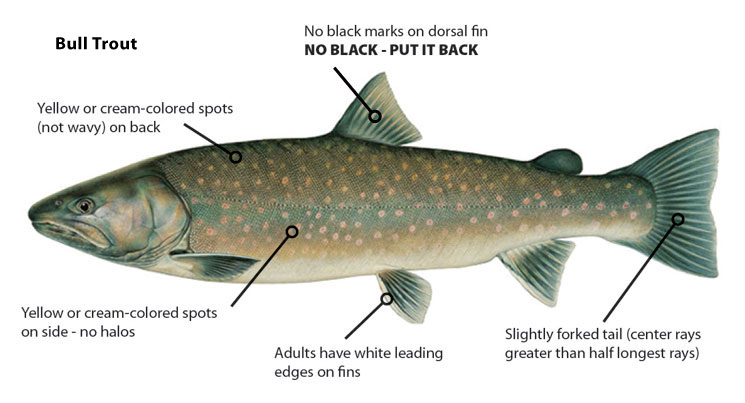
                Bull trout can be easily distinguished from other trout species due to their lack of spots on the dorsal fin, olive green to bronze skin, and yellow to salmon-pink colored spots on the fish’s back. It also does not share the same forked tail as many other trout. 

www.takenobull.org/images/articles/bull-trout-diagram.jpg
  Geographic Range

                                                                      The Bull Trout is Native to Northwestern-North America. To the left, you can see the range of the Coastal Recovery Unit, put in place to help recover this threatened species. Efforts are underway primarily in the Puget sound region, however the map shows that the Bull Trout is being tracked and protected across Oregon and most of Washington.

The Puget Sound region and the Olympic Peninsula region are the only known regions to support anadromous bull trout according to the US fish and wildlife service. An anadromous species is one that spawns in freshwater but migrates to saltwater to mature. These migratory trout have been reported to grow up to 35 inches long and to weigh as much as 32 pounds!

Coastal Recovery Unit Implementation Plan for Bull Trout

https://ecos.fws.gov/ecp0/profile/speciesProfile?spcode=E065
          According to the Endangered Wildlife Coalition, bull trout have been extirpated from much of their historic range. They usually thrive in very cold waters, well vegetated flood plains, and undeveloped areas. The lack of human development allows the streams to create pools and side channels for the fish to spawn in. 

Listings


https://www.fws.gov/pacific/bulltrout/pdf/~1078458.pdf

The bull trout was first put on the endangered list as a threatened species in June of 1998. In December of 2009, the US Fish and Wildlife service began monitoring an experimental population in Flathead County Northwest Montana. Since then, there have also been populations found and monitored in other nearby states such as Oregon.

Threats to the Species

http://www.rmecinc.com/project/old-fall-river-road/

The largest threat to the bull trout is habitat degradation. Since Bull trout have such a low tolerance for changing environments, they are an excellent indicator species for the health of the waterways. When rivers and streams are reinforced, they cannot turn and bend as they naturally would, therefor eliminating many of the pools and swells that the bull trout love to live and spawn in. Humans have had an enormous effect on the waterways and on the trout by correlation. As areas become more developed and roadways expand, bull trout range and populations continue to shrink. Climate change and global warming are also expediting the extirpation of the bull trout. As ambient air temperatures rise, the stream water temp is rising as well. This, and the reduced water flowing due to drought and redirection for use in hydroelectric generators has completely cutoff the spawning grounds for many of the bull trout. Since the bull trout need to swim much farther upstream to reproduce, they are often running into roadblocks, or river-blocks, such as damns, roads, dikes, and dry spots.
http://www.riversportfishing.com/wp-content/uploads/sea-run-bulltrout-wm.jpg
                Another large and very real threat to the bull trout is recreational fishing. They are often mistaken for other similar types of fish and caught accidentally. The illegal fishing of bull trout is just adding to the population decline and could end up labeling the bull trout as an endangered species rather than just threatened.

What is being done?


Since the addition of the bull trout to the list of endangered species, efforts have been made by everyone from the federal government, state agencies, and conservation activists to power companies and local landowners. Fortunately, many of the conservation efforts put in place to save the bull trout overlap with those put in place to save salmon and steel head populations. Since “bull trout consistently migrate to the furthest accessible upstream habitats in their natal watersheds and require some of the coldest and cleanest water conditions for parts of their life cycle,” saving the habitat upstream has a direct effect on the endangered fish downstream. (US Fish)


https://www.americanrivers.org/conservation-resources/river-restoration/

 The biggest effort being made is habitat preservation, since that is what has the largest effect on the bull trout’s survival.


It is up to us...
       ...to save the bull trout. By limiting our influence on naturally occurring waterways, one would have a huge impact on the survival of the bull trout as well as other trout and salmon. One can also take action by using local governments to pressure power providers to create bypasses to their damns and hydro-electric power plants so that the trout can continue their journey up stream. The easiest thing one can do to ensure the safety of the bull trout is to research local conservation agencies, and make a donation. These agencies run on limited funds and rely heavily on the donations of concerned citizens.

References
  • https://www.nrcs.usda.gov/wps/portal/nrcs/detail/mt/home/?cid=nrcs144p2_057914
  • http://www.endangered.org/animal/bull-trout/
  • https://ecos.fws.gov/ecp0/profile/speciesProfile?spcode=E065
  • crag.org/clean-water/bull-trout/

Works Cited

“Bull Trout.” Crag Law Center, crag.org/clean-water/bull-trout/.

“Bull Trout.” Endangered Species Coalition, www.endangered.org/animal/bull-trout/.

Service, U.S. Fish and Wildlife. “Bull Trout (Salvelinus Confluentus).” Species Profile for Bull Trout (Salvelinus Confluentus), ecos.fws.gov/ecp0/profile/speciesProfile?spcode=E065.

“Threatened and Endangered Species Bull Trout Fact Sheet.” USDA Natural Resources Conservation Service Montana, www.nrcs.usda.gov/wps/portal/nrcs/detail/mt/home/?cid=nrcs144p2_057914.

US Fish and Wildlife Office, and Oregon Fish and Wildlife Office. “Coastal Recovery Unit Implementation Plan for Bull Trout.” Sept. 2015, Coastal Recovery Unit Implementation Plan for Bull Trout.