Wednesday, March 7, 2018

Pacific Western Snowy Plover - Edmund Slevin

The Pacific Western Snowy Plover

By: Edmund Slevin


Introducing the Pacific Western Snowy Plover


The Snowy Plover is a small coastal bird that is 16.5 cm tall on average. Typically, Western Snowy Plovers weigh about 34 to 58 grams. It has a round head and short neck with a long, pointed black beak. The Plover has white plumage on its underside and grey-brown on the top part of its body. The Snowy Plover also has black highlights and medium sized legs relative to its body. The average lifespan of the Snowy Plover is 3 years, however there has been an instance of an individual Snowy Plover growing to 15 years old. The Western Snowy Plover typically nests and breeds above the high tide line on beaches in sand dunes, sand spits and on sparsely vegetated sand dunes.


Where They Are Found


The Western Snowy Plover mainly lives on West Coast beaches from the Central Coast of Washington State down to the horn of Baja-California. The plover also has interior (non-coastal) populations in “Oregon, California, Nevada, Utah, New Mexico, Colorado, Kansas, Oklahoma, and north-central Texas, as well as coastal areas of extreme southern Texas, and possibly extreme northeastern Mexico” (Recovery Plan,5). The two populations, coastal and interior, typically do not interbreed with each other.


Population


Usually, 1-315 adults will settle in a suitable breeding location depending on area of land. In 2006, it was estimated that 70 Plovers were found in Washington State statewide, 179 found in Oregon statewide, somewhere between 1000-2000 statewide in California and 1,344 found in Baja California, Mexico. The Snowy Plovers largest breeding grounds are from San Francisco Bay to Southern Baja California. The Plovers are declining rapidly in certain areas but remaining stable in others however, future populations are expected to decrease rapidly due to habitat loss and degradation. Populations are naturally slow growing due to infrequent breeding with small broods. Typically, the plovers lay three eggs twice a year. Breeding requires long portions of time. Before breeding can begin, a nest must be constructed in a display of courtship. After this the process of mating can take anywhere between 3 days to a month and a half. Once the plovers have mated, the gestation period is 4-5 days followed by 26 to 31 days of incubation before hatching. The Plover does, usually, successfully hatches two broods annually with the help of both the male and female. The fledgling success rate average is only 37.5%.


Listings


Threatened; USFWS listing under Endangered Species Act, March 5,1993
Near Threatened; IUNC listing under IUNC Red List, (most recent) 2014 and 2016


Threats to the Plover


Although the geographic location of the Snowy plover causes different variations of threats, the primary threat to the species faces is the destruction of their coastal habitat. Oceanside housing and development in grassy sand habitats. These developments have caused habitat destruction in some regions and habitat degradation in others. The loss of habitat decreases nesting grounds and reproduction which has led to a negative population growth. This species also is affected by individuals that disrupt their habitats indirectly through recreation and removal of dune vegetation that stabilizes the sand. Introduced beach grass has also become an issue for the Snowy Plover because it is unable to nest around certain grasses. Expansion of predator populations is another growing threat as well. Predators of the Plover include foxes, coyotes, crows, owls, various other bird species, skunks, raccoons, and cats; the majority of the species drastically affecting the Pacific Snowy Plover are non-native. Disease is beginning to affect the Plover populations as well. Avian Botulism is a disease that the Plovers are susceptible to and it is thought that an outbreak could occur in certain populations. West Nile Virus, which has killed many bird species, is also a growing threat to the plovers in affected areas. The decline in population has warranted threatened status for the species and conservationists are worried the species could be susceptible to a drastic decline at any time.


Recovery Plan


Since listed as a threatened species, more conservation action has been put into place. Many areas that act as habitats for Snowy Plover populations have been protected in efforts to halt detrimental habitat loss. Man made habitats have been formed in order to increase the number of mating pairs in certain areas. Enclosures around nesting sites have also been constructed in order to reduce accessibility for predators. Motor vehicle use in and near Plover habitats has been prohibited and other recreational activity has been limited in many areas. Public exposure and education for the issue in coastal communities has also decreased the amount of human disruption. Conservationists have been monitoring nesting grounds and predators. Staying up to date on threats to the Snowy Plover is also very important for this species because of its numerous different risks to population size.


What can you do


The best way to personally benefit the Snowy Plover is to avoid recreational activities in beach grass areas where the Snowy Plover nests. Slight disruption to their nesting grounds can make it difficult for successful breeding. This should especially be taken into consideration when visiting a beach that is known for having Snowy Plovers. If you are a resident of a beach community or live near a beach community, attempt to vote against developments taking place near the beachfront as this is a common place for nesting Plovers. Keep dogs under control or on leash while at the beach because dogs have been known to disrupt and sometimes even kill the Snowy Plover.


Other resources


Fish and Wildlife Services: Western Snowy Plover full Recovery Plan
IUCN Red List: Western Snowy Plover- overview of why Snowy Plovers are on the Red List
All About Birds: Western Snowy Plover- statistics and overview of Snowy Plover
Wikipedia: Western Snowy Plover
Piper: Short Movie by Pixar


Citations:

The IUCN Red List of Threatened Species: Charadrius nivosus


BirdLife International. 2017. Charadrius nivosus (amended version of 2016 assessment). The IUCN Red List of Threatened Species 2017: e.T22725033A119724388. http://dx.doi.org/10.2305/IUCN.UK.2017-3.RLTS.T22725033A119724388.en. Downloaded on 05 March 2018.


All About Birds: Snowy Plover


“Snowy Plover Overview, All About Birds, Cornell Lab of Ornithology.” Overview, All About Birds, Cornell Lab of Ornithology, 2017, www.allaboutbirds.org/guide/Snowy_Plover/overview. Downloaded on 05 March 2018.

Recovery Plan for the Pacific Coast Population of the Western Snowy Plover

U.S. Fish and Wildlife Service. 2007. Recovery Plan for the Pacific Coast Population of the Western Snowy Plover (Charadrius alexandrinus nivosus). In 2 volumes. Sacramento, California. https://www.fws.gov/arcata/es/birds/WSP/documents/RecoveryPlanWebRelease_09242007/WSP_Final_RP_10-1-07.pdf. Downloaded on 05 March 2018.

Snow Leopard: Corte Smith


Snow Leopard: Panthera Uncia
by Corte Smith
Snow Leopard


Description:

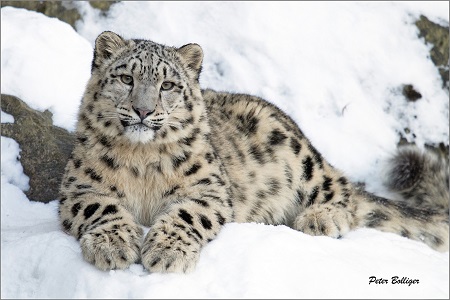
The snow leopard's fur, which is thick with hairs between 5 and 12 cm long, is whitish to gray with black spots on head and neck, but larger rosettes on the back, flanks and bushy tail. Its tail is 80 to 105 cm long. Its body is stocky, short-legged and slightly smaller than the other cats reaching a shoulder height of 56 cm, and ranging in head to body size from 75 to 150 cm. Its eyes are pale green or gray in color. Its muzzle is short and its forehead domed. Its nasal cavities are large. It weighs between 22 and 55 kg, with an occasional large male reaching 75 kg and small female of under 25 kg. Snow Leopards lives no longer than 20 years, however can live up to 28 years in captivity.

Where to find Snow Leopards
The Snow Leopard can be found in the mountain ranges of Central and South Asia. The global population is estimated to number 4,000- 7,000 mature individuals. The population is declining about 10% in the next 23 years.

The snow leopard inhabits alpine 
and subalpine zones at elevations from 3,000 to 4,500 m, ranging from western Afghanistan to Mongolia and western China. In the northern range countries, it also occurs at lower elevations (Snow Leopards."Wikipedia"). 
Ecology:
The snow leopard is solitary, except for females with cubs. They hide their cubs in dens in the mountains for extended periods.
Mother and her cubs waiting outside den
An individual snow leopard lives within a well-defined home range, but does not defend its territory aggressively when encroached upon by other snow leopards. Home ranges vary greatly in size. Where prey is abundant, a home range may be as small as 12 km2 to 40 km2  and up to five to 10 animals are found here per 100 km2; in habitats with sparse prey, though, an area of 1,000 km2 supports only five of these cats. However, a new study lasting from 2008 to 2014 indicates their ranges are much greater than believed; a male snow leopard requires a territory of around 80 square miles, while females require up to 48 square miles of territory. Taking this data into account, it is estimated that 40 percent of the 170 protected areas in place are smaller than the space required to support a single male snow leopard.

Behavior:

Snow Leopards camouflaged while napping during the daylight

Like other cats, snow leopards use scent marks by scraping the ground with the hind feet before depositing urine or scat, but they also spray urine onto sheltered patches of rock to indicate their territories and common travel routes.
Snow leopards are most active at dawn and dusk They are known for being extremely secretive and well camouflaged (Sayano).


Diet:

Snow Leopards are one of the top predators in the high mountain food web of Central Asia. The Snow Leopard can kill prey three times their weight. Blue Sheep and Ibex are some of the Snow Leopards favor meals (“What”).

Snow leopard stocking a goat
Snow Leopards are Carnivores that are opportunists when it comes to feeding. They ambush their predators and will attack from above when possible. The Snow Leopard can jump as far as 14 meters to catch its prey. The Snow Leopard will feed on its kill for 3 to 4 days  (“Snow Leopard- Facts”).


Snow Leopard Conservation Status:
In 1972, the IUCN placed the snow leopard on its Red List of Threatened Species as ‘Endangered’. Due to the high demand for their coats, snow leopards are illegally hunted for the fur trade. The pelts are a sought-after commodity in places like Central Asia, Eastern Europe and Russia where they are turned into coats and other garments. Snow leopard bones and body parts are also used for traditional Asian medicine.
There are numerous agencies working to conserve the snow leopard and its threatened mountain ecosystems. These include the Snow Leopard Trust, the Snow Leopard Conservancy and the Snow Leopard Network. Their focus on research, community programs in snow leopard regions and education programs are aimed at understanding the cats needs as well as the needs of the villagers and herder communities impacting the snow leopard’s life and habitat (“Snow Leopard- Facts”).

What you can do:

You can directly support these efforts by joining the International Snow Leopard Trust or – even better – by purchasing some of the handicrafts made by the people who are the MOST important link in ensuring the cats survive in the wild for ever. Please visit The international Snow Leopard Trust Web-site: www.snowleopard.org for more general information about snow leopards in the wild. Go to the Irbis Enterprises Web-site to see products made by the herders and to learn more about conservation efforts in Mongolia www.irbis-enterprises.com Thanks so much for your passion for cats, they need all the help we can give("Saving")!

Interesting facts:
 Snow Leopards playing
Snow leopards are very playful, love to roll in the snow. They often slide down a steep hill at the back and at the end they quickly turn over and fall into the snow on all four paws. After the games, or hunting they make themselves comfortable to bask in the sun.
Being in a good mood, the snow leopard purrs just like a house cat. Snow Leopards also can not roar (Sayano). 


Sources:

https://bigcatrescue.org/save-snow-leopards/ 

“Saving The Snow Leopards.” Big Cat Rescue, 17 Jan. 2018, bigcatrescue.org/save-snow-leopards/.
http://snowleopardconservancy.org/wp-content/uploads/2017/09/bolliger-resized-sl1.jpg (photo)

Sayano-Shushenskiy Reserve. “About the Snow Leopard.” ABOUT THE SNOW LEOPARD, Russian Geographical Society, 2017, www.rgo.ru/en/projects/protection-endangered-species-snow-leopard/about-snow-leopard.

“Snow Leopard - Facts, Diet & Habitat Information.” Animal Corner, 2018, animalcorner.co.uk/animals/snow-leopard/.

“Snow Leopard.” Wikipedia, 22 Feb. 2018, 12:36, en.wikipedia.org/wiki/Snow leopard.


“What do snow leopards eat?” Snow Leopards for Kids, Snow Leopard Conservancy, 2008, http://snowleopardconservancy.org/kids/text/leopardfood.htm.

Florida Panther - Shane Simpson

The Florida Panther

National Geographic Blog

About the Florida Panther:
                                                                                                                                                                      MySuncoast.com
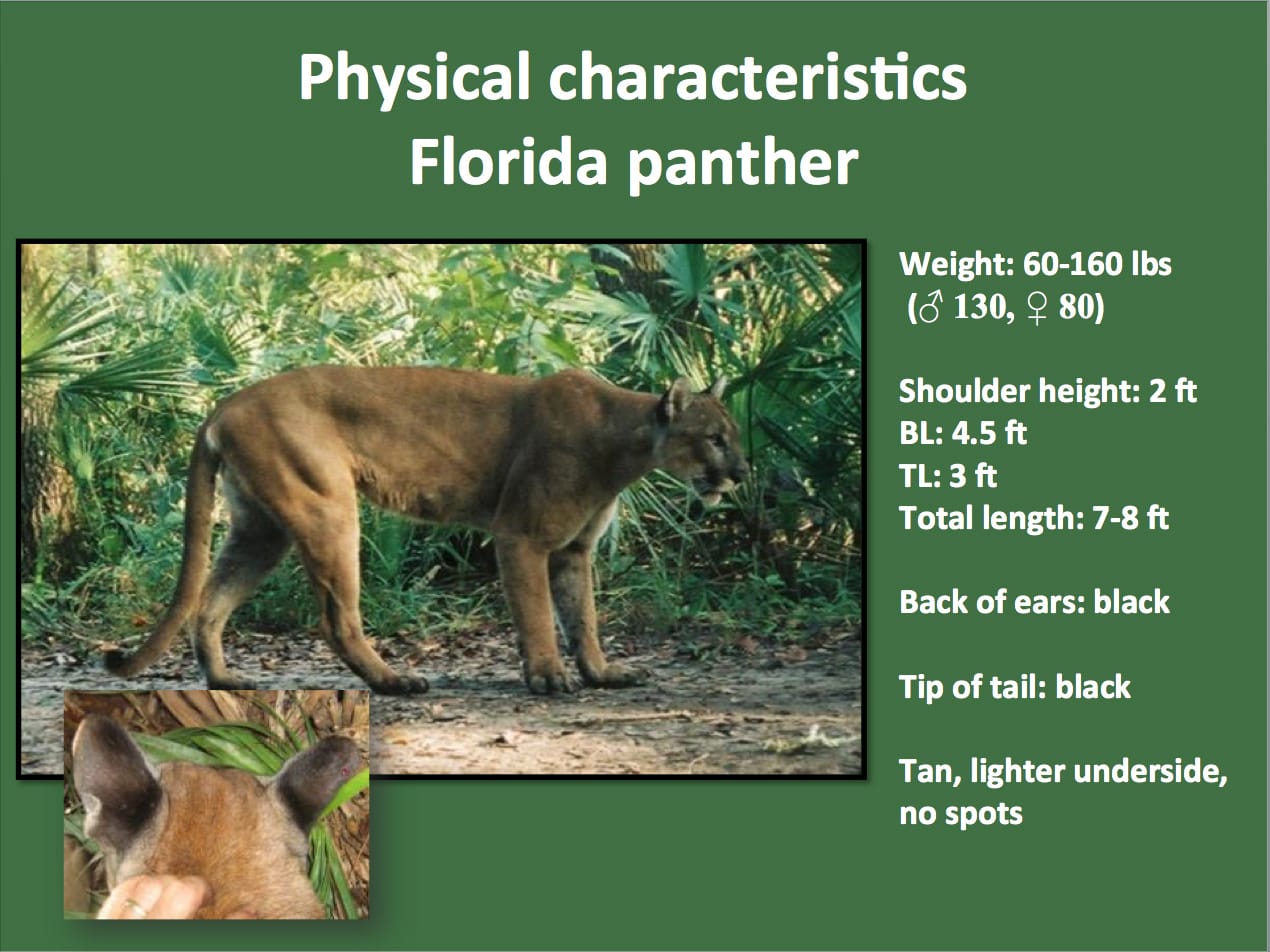
The Florida panther is the last subspecies of the Puma still living in the Eastern U.S.  However, this cat historically inhabited the southeastern U.S. as well.  Their population has decreased to 5% of their historic range, leaving only 100-120 panthers remaining (Florida).  Panthers are generalists, as they utilize diverse habitats such as forests, prairies, and swamps.  These territorial animals have a home range of 200 miles for males and 75 miles for females. Panthers rest during the day and are active between dusk and dawn (Basic).  Panthers are exclusively carnivores, 90% of their diet is feral hog, white-tailed deer, raccoon, and armadillo.  Rabbits, rats, and birds are occasionally consumed as well (Species).  Male panthers are polygynous, their large home ranges overlap consisting of several females (Florida).  Today the breeding range for the Florida panther is restricted to south of the Caloosahatchee River (Basic).
Ralph Arwood Photography

Why is the Florida Panther so Important?

Panthers are an umbrella species, therefore, they protect and preserve the ecology of the expansive landscapes and habitats panthers live in.  Florida panthers keep the populations of feral hogs, deer, raccoons and other prey balanced and robust (Basic).

What Caused the Florida Panther's Population to Dwindle?  What are the Threats Today?

In 1892 a bounty was placed on panthers because they were perceived as a threat to humans, livestock, and game animals.  Consequently, by the mid-1950s the species was nearly extinct (Species).  In 1967 the Florida panther was named an endangered species, the population was decimated to only 12 to 20 individuals (Threats).  Today, habitat loss, roadkill, and genetic diversity are the main drivers that inhibit panther population growth.

Ethan Strickler: Slideshare
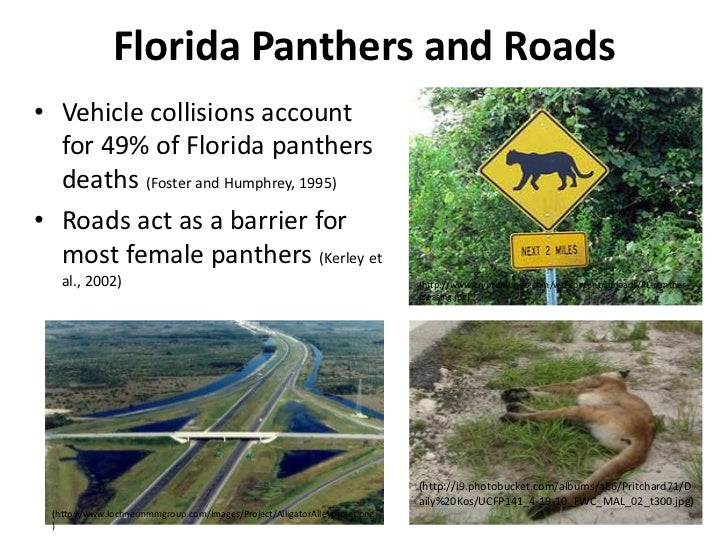
Habitat loss, fragmentation, degradation, and human disturbance are the greatest threats to the panther population.  Economic and human population growth driving urbanization and agricultural expansion is expected to cut Southeast forest land 5-8% between 1992 and 2020 (Florida).  This greatly disturbs panther population growth as panthers need large home ranges to hunt and find mates.  Related to urbanization and habitat loss, Southeast Florida highways and roadways are also expanding.  Collisions with motor vehicles have increased substantially, with a record 25 panther deaths from vehicles in 2014.  Biologists believe that this is causing the cats to not cross the Caloosahatchee River (Threats).

As the Florida panther's population declined and became isolated from subspecies, inbreeding became commonplace.  This greatly suppressed the genetic diversity of the panther population.  In 1995 the U.S. Fish and Wildlife Service temporarily released eight female panthers from Texas to genetically restore the Florida panther population.  This program succeeded and the Florida panther population tripled in 11 years (Florida).

Recovery Plan:

The recovery plan (Recovery):
Big Cat Rescu
  1. Restore and expand the panther population and habitat in south Florida.
  2. Expand this population to south-central Florida.
  3. Reintroduce at least two panther populations outside of south and south-central Florida within their historic range.
  4. Create public awareness and educate the public about the cause.
  5. Incentivize private landowners to retain and protect panther habitats.
  6. Conserve the habitat and have thorough and careful land use planning.
  7. Minimize habitat damaging threats.

Unturned Wiki-Fandom
What Can You Do?
  1. Adopt a Panther- This helps Defenders of Wildlife work with state and local officials to preserve the habitat and construct highway underpasses.
  2. Send a message to government regulators and officials.
  3. Talk to friends, neighbors, and family about why protecting wildlife matters.
  4. Stay informed.
Resources Used:

“Basic Facts About Florida Panthers.” Defenders of Wildlife, 3 Oct. 2016, defenders.org/florida-panther/basic-facts.
The Florida Panther Recovery Team. “Florida Panther Recovery Team.” Florida Panther Recovery Team, 13 Mar. 1995, pp. ii-216. https://ecos.fws.gov/docs/recovery_plan/081218.pdf
“Florida Panther: Species Profile.” National Parks Service, U.S. Department of the Interior, www.nps.gov/ever/learn/nature/floridapanther.htm.
“Threats to Florida Panthers.” Defenders of Wildlife, 19 Sept. 2016, defenders.org/florida-panther/threats.